
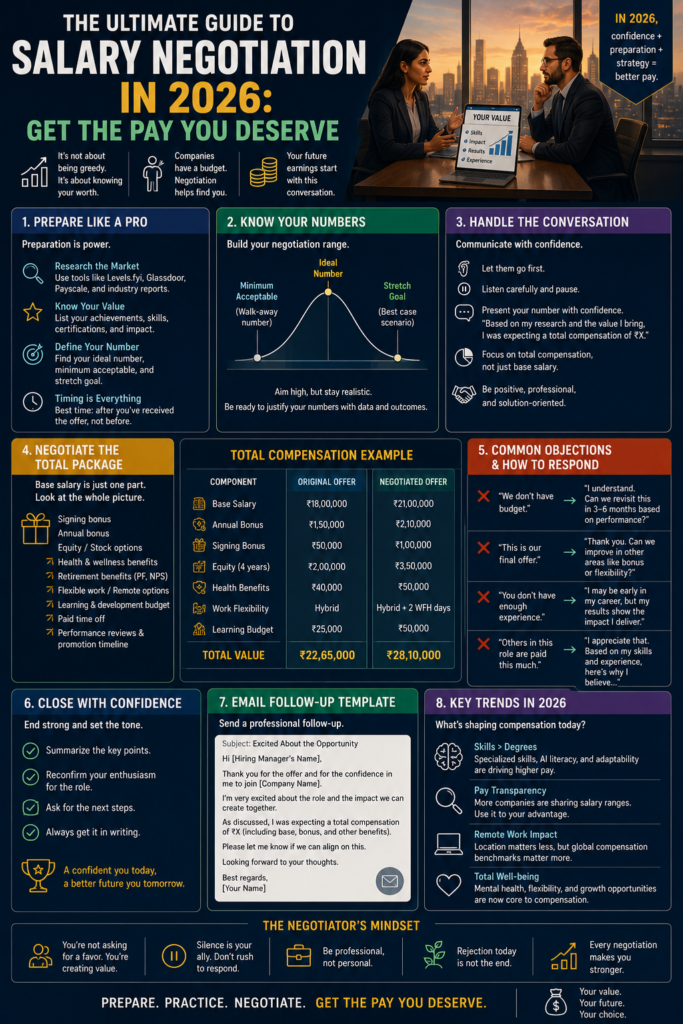
Let’s be real: talking about money can be awkward. It’s a feeling many of us share, whether we’re fresh out of college, looking to switch careers, or simply trying to get a better deal at our current job. But in 2026, especially in a competitive job market, salary negotiation is no longer optional
it’s a critical skill. Knowing how to negotiate effectively can significantly impact your financial well-being over your career, potentially adding up to hundreds of thousands of dollars. This guide isn’t just about getting a higher starting salary; it’s about understanding your worth and securing a compensation package that reflects your value.
Why Salary Negotiation Matters More Than Ever
In 2026, the landscape of employment has changed. With the rise of salary transparency, economic shifts, and evolving workplace expectations, salary negotiation is more critical than ever. It’s a key factor in your overall financial health and professional satisfaction.
- Fair Compensation: Salary negotiation ensures you’re paid what you deserve based on your skills, experience, and market value.
- Long-Term Impact: Your starting salary impacts your long-term earnings, retirement savings, and overall financial well-being.
- Professional Respect: Negotiating demonstrates confidence and signals your understanding of your value to both your employer and yourself.
Ignoring this crucial step can mean leaving significant money on the table, potentially costing you a substantial amount over the course of your career.
Before You Begin: Laying the Groundwork for Success
Before you even think about the negotiation itself, you need to prepare. This preparation phase is where the real work happens. Think of it as building a strong foundation before constructing a building. Without it, the negotiation will likely crumble.
1. Research is Your Secret Weapon
Knowledge is power, and in salary negotiation, data is your most powerful tool. You need to know your market value. This involves understanding what people with your skills,
experience, and in your location are earning. Relying on gut feelings or simply hoping for the best is a recipe for undervaluing yourself. Here’s how to gather the right data:
- Online Salary Resources: Use websites like Glassdoor, Payscale, and LinkedIn Salary to get a clear picture of salary ranges for your role, industry, and location. Don’t just look at the average; aim for the higher end of the range if you have above-average skills or experience.
- Industry Benchmarks: Explore industry-specific salary surveys and reports. These can provide more granular data tailored to your specific field.
- Company Research: Investigate the company’s financial health, recent news, and hiring trends. If a company is struggling or has frozen hiring, your negotiation room might be limited.
2. Assess Your Value
What do you bring to the table? This isn’t just about your job title; it’s about the unique value you offer. Consider the following:
- Skills: What technical and soft skills do you possess?
- Experience: How many years of experience do you have, and what specific accomplishments can you highlight?
- Achievements: Quantify your achievements whenever possible. Did you increase sales by a certain percentage? Did you streamline a process and save the company money? Numbers speak volumes.
- Certifications and Education: Do you have any special certifications or advanced degrees that add value?
3. Know Your Walk-Away Point
What is the absolute minimum you’ll accept? This is crucial. Determine your financial needs and what salary would allow you to comfortably live and meet your financial goals. Knowing your minimum helps you avoid accepting an offer that doesn’t meet your needs. It also gives you the confidence to walk away if the negotiation doesn’t go your way.
The Negotiation Process: Steps to Take
Now that you’ve done your homework, it’s time to move on to the actual negotiation. Here’s a step-by-step guide to help you navigate the process confidently:
1. Timing is Everything
When is the right time to negotiate? Generally, it’s best to wait until you receive a formal, written job offer. This signals that the employer is genuinely interested in hiring you. If you’re an existing employee, the performance review cycle is a natural time to discuss compensation.
2. Express Gratitude and Ask for Time
When you receive the offer, show genuine enthusiasm, and thank the hiring manager for the opportunity. Then, ask for a reasonable amount of time (24-48 hours is standard) to review the offer thoroughly. This gives you time to consider the details and prepare your counteroffer without feeling rushed. It also signals that you are taking the offer seriously.
3. Present Your Counteroffer Confidently
When you respond, be professional and confident. Start by reiterating your excitement about the role and the company. Then, state your desired salary range, backed by your research and the value you bring.
Example: “Thank you so much for the offer. I’m very excited about the opportunity. Based on my research of market benchmarks for similar roles with my experience and skills, I was hoping for a salary in the range of $X to $Y.”
4. Justify Your Request
Don’t just state a number; explain why you deserve it. Highlight your achievements, skills, and how they align with the company’s needs. Use specific examples and quantify your accomplishments whenever possible.
Example: “In my previous role, I was responsible for [specific achievement], which resulted in a [quantifiable result]. I am confident I can bring that same level of success to this role.”
5. Be Prepared for Pushback
The hiring manager may not immediately agree to your request. Be prepared for potential questions or objections. Stay calm, and be ready to reiterate your value proposition and potentially adjust your expectations slightly.
6. Consider the Whole Package
Salary isn’t everything. Think about the entire compensation package, including benefits, bonuses, and perks. If the base salary is non-negotiable, explore other areas:
- Benefits: Health insurance, retirement plans, paid time off.
- Bonuses: Signing bonuses, performance-based bonuses.
- Perks: Remote work options, professional development opportunities, stock options.
7. Know When to Stop
There comes a point when further negotiation won’t yield results. After a few back-and-forths, if you can’t reach an agreement, it’s time to decide whether to accept the current offer or walk away. Do so professionally, and thank the employer for their time and consideration.
Common Mistakes to Avoid
Even with careful preparation, it’s easy to make mistakes that can hinder your negotiation success. Here are some common pitfalls to avoid:
- Not Negotiating at All: This is the biggest mistake. Many people are afraid to negotiate and miss out on potential earnings.
- Accepting the First Offer Immediately: This limits your options and potential earnings.
- Revealing Your Salary Requirements Too Early: Try to delay discussing salary until the employer has expressed strong interest in hiring you.
- Being Unprepared: Entering a negotiation without proper research and understanding of your worth is a disadvantage.
- Getting Emotional: Stay calm and professional throughout the process.
Real-World Examples: Putting it All Together
Let’s look at a few examples to illustrate how these strategies can play out in real life.
Scenario 1: New Graduate
Sarah is a recent college graduate with a degree in marketing. She has been offered a marketing role at a tech company. She researched the average salary for marketing roles in her city and found a range of $60,000-$70,000. The initial offer is $58,000. Sarah, after expressing her enthusiasm for the position, responds,
“Thank you for the offer. Based on my research and the skills I developed during my internship, where I was able to increase lead generation by 15%, I was hoping for a salary in the range of $65,000 to $70,000.” She then highlights her experience using marketing software and her ability to work independently.
Scenario 2: Experienced Professional
Mark is an experienced software engineer. He is offered a new position. The initial offer is $100,000, but his research reveals that the market rate for his role and experience level is $110,000-$125,000. Mark expresses his gratitude and then states, “I am excited about this opportunity.
Based on my experience leading successful projects and my understanding of the market, I believe a salary between $115,000 and $125,000 would be appropriate.” He then provides specific examples of his past achievements and how they align with the company’s needs.
Scenario 3: Current Employee
Jessica has been with her company for three years and consistently exceeds expectations. During her performance review, she is ready to discuss her salary. She’s prepared a list of her achievements, including specific examples of how she has saved the company money and increased revenue.
She also researched average salaries for her role in her area. When the time is right, she states, “I am proud of my accomplishments over the past three years. Given my contributions, and based on the current market value for my position, I am seeking a salary increase to reflect this.”
These examples underscore the importance of preparation, confidence, and using data to support your requests. By following these steps, you can increase your chances of securing a salary that reflects your value.
Beyond the Numbers: Additional Considerations
Salary negotiation is about more than just the base pay. Consider these additional factors:
- Company Culture: Does the company value its employees? Is there a good work-life balance?
- Growth Opportunities: Are there opportunities for professional development and advancement?
- Benefits: What’s the health insurance like? What are the retirement options?
- Location: Consider the cost of living and transportation costs.
Frequently Asked Questions
Here are some frequently asked questions about salary negotiation:
- When should I start the salary negotiation?Ideally, start the negotiation after you receive a formal job offer, before you accept it. If you’re an existing employee, this is typically done during performance reviews or when you’ve taken on new responsibilities.
- What if they ask about salary expectations early in the process?Try to avoid answering directly. You could say, “I’m more interested in learning more about the role and responsibilities before discussing salary expectations. What is the salary range for this position?”.
- What if they say the salary is non-negotiable?You can still try to negotiate other aspects of the compensation package, such as benefits, bonuses, or remote work options. If that is not possible, and the salary is below your minimum, you may need to consider other options.
- How many times should I counteroffer?It’s generally best to counteroffer once or twice at most. Dragging out the negotiation can frustrate the hiring manager. Know when to walk away.
- What if I’m a new graduate with no experience?Even with limited experience, you can still negotiate. Highlight your skills, education, any relevant projects or internships, and your willingness to learn. Research entry-level salaries in your field.
- Is it okay to ask for a higher salary for a role that I am interested in but for which I am not 100% qualified?Yes, if you can demonstrate value. If you can show a strong grasp of the required skills, a desire to learn, and transferable skills from other roles, you can absolutely negotiate. Make sure you highlight your strengths, and be prepared to take on additional responsibilities.
- What if I don’t feel comfortable negotiating?It’s normal to feel uncomfortable, but remember that negotiation is a skill that can be learned. Start by practicing with a friend or mentor. Focus on preparing your arguments and knowing your worth. Consider that it is expected.
- How can I prepare a strong value validation project (VVP) for salary negotiations?Focus on your accomplishments, specific examples, and quantifiable results. These projects can include goals you’ve met, revenue you’ve helped generate, or awards you’ve earned.
Conclusion: Take Control of Your Career
Salary negotiation is a crucial step in building a successful career. It’s an opportunity to advocate for yourself and secure the financial stability you deserve.
By following this guide and putting in the necessary work, you can confidently navigate the negotiation process and increase your chances of getting the pay and benefits you want.
Remember to research, assess your value, practice your pitch, and be prepared to walk away if the offer doesn’t meet your needs. Take control of your career, and start building the future you envision. For more on career development, visit Guidebloom.
This is where most people rush, but the real difference happens when you take the time to prepare properly. If you skip this part, problems appear later, but this guide will ensure you will be successful in your negotiation.
Finding Your Voice and Living Authentically in a World is important, and understanding your value is a huge part of that. Finding Your Voice and Living Authentically in a World can also help.