
Ever felt that sinking feeling after an exam, the one where you *swear* you knew the material, but your brain just… blanked? We’ve all been there. Hours spent poring over textbooks, notes covered in highlighter streaks, the illusion of understanding firmly in place.
Then, the exam arrives, and it’s like your brain did a disappearing act. This isn’t just about feeling frustrated; it’s about wasted time, energy, and, frankly, a dent in your confidence.
The truth? The way most of us approach learning is, well, not very effective. We’re often stuck in habits that feel productive but deliver minimal results. The good news? You can train your brain to remember. It’s not about being “smart,” it’s about using the right strategies. Let’s ditch the myths and dive into how real learning actually happens, along with practical methods to make it stick.
The Learning Lie: Why Rereading Notes Doesn’t Cut It
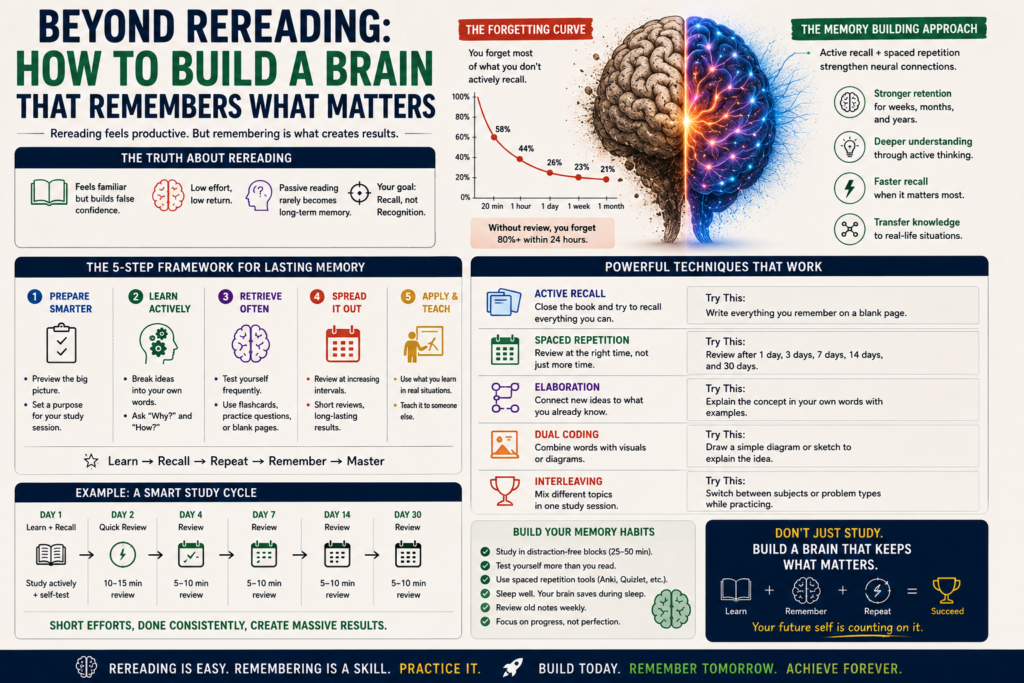
Let’s address the elephant in the room: rereading your notes. This is the comfort food of studying. It feels familiar, it feels safe, and it *feels* like you’re absorbing the information.
But here’s a harsh truth: rereading is often a colossal waste of time. You might recognize the words, you might even feel a sense of familiarity, but that doesn’t mean the information is securely locked in your long-term memory.
Rereading often creates what’s called a “fluency illusion”. You *think* you know it because it flows smoothly, but under pressure, that knowledge vanishes.
Real understanding begins when you can recall information without looking at it. Can you explain a concept in your own words? Can you answer questions about it without consulting your notes? If not, you’re likely stuck in the trap of passive learning, and the knowledge isn’t truly yours.
How Real Learning Works: It’s All About Connections
So, if rereading is a no-go, how our brain actually learn and remember? It’s all about making connections. When you encounter new information,
your brain doesn’t just store it in a vacuum. Instead, it links it to things you already know, like a vast network of interconnected ideas. These connections act as “hooks” that help you retrieve the information later. The more hooks you have, the easier it is to recall what you’ve learned.
Think of it like this: imagine trying to find a specific book in a library. If the books are just randomly scattered around, it’s a nightmare. But if they’re organized by subject, author, and genre, you can quickly locate what you need. Your brain works the same way. The more organized and interconnected your knowledge, the easier it is to find and use it.
The Practical Toolkit: Methods That Actually Work
Okay, enough theory. How do we put this into practice? Here are some effective strategies to build a brain that remembers:
- Active Recall: This is your secret weapon. Instead of passively rereading, actively try to recall the information from memory. Test yourself frequently. Use flashcards. Try to explain concepts out loud, without looking at your notes. This forces your brain to work, strengthening the neural pathways and making the information stick.
- Spaced Repetition: This is the art of reviewing information at increasing intervals over time. It’s like building muscle – you don’t lift weights once and expect to be strong. You gradually increase the weight and the frequency of your workouts. Similarly, spaced repetition involves revisiting material, initially soon after learning it, and then at longer and longer intervals. This technique, also called spaced practice, is very effective for long-term retention.
- Interleaving: Instead of studying one subject for hours, mix it up. Spend 25 minutes on math, then 25 minutes on history, then 25 minutes on science. This forces your brain to work harder, making it better at distinguishing between different concepts. Interleaving is a great study skill.
- Make it Meaningful: Connect new information to what you already know. Relate it to your own experiences, create examples, and ask “why” and “how” questions. The more meaningful the information is to you, the easier it will be to remember.
- Use Mnemonics: These are memory aids that help you remember information by creating associations. This could be acronyms, rhymes, or even visual imagery. For example, the acronym “ROY G. BIV” helps you remember the colors of the rainbow.
The Mistakes Almost Everyone Makes
We’ve talked about what works. Now, let’s look at what *doesn’t* work, and the common pitfalls that sabotage your learning:
- Cramming: This is the emergency button of studying. It might get you through the exam, but it’s terrible for long-term retention. Information crammed in at the last minute rarely sticks.
- Multitasking: Trying to study while checking your phone, listening to music, or watching TV is a disaster. Multitasking severely reduces your focus and impairs memory consolidation.
- Ignoring Feedback: Don’t brush off your mistakes. Analyze them. Understand *why* you got something wrong. This is how you truly learn and improve.
- Memorizing Without Understanding: Don’t just memorize facts; understand the underlying concepts. Understanding allows you to apply the knowledge in different situations, whereas rote memorization is often useless.
Beyond the Exam: The Long-Term Impact
Improving your learning ability isn’t just about acing exams. It has a profound impact on your confidence and performance in all areas of your life. When you know how to learn effectively,
you become more adaptable, resourceful, and resilient. You’re less afraid of new challenges and more confident in your ability to master new skills. This can have a positive effect on all aspects of your life, from your career to your personal relationships.
Think about it. If you believe in your ability to learn, you’re more likely to embrace new opportunities, take on bigger challenges, and achieve your goals.
This self-belief translates to a higher level of performance in every aspect of your life. Imagine the power of a brain that remembers what matters, whether it’s at the workplace, in your hobbies, or any other area where you want to grow.
Furthermore, developing solid learning skills can lead to a deeper sense of accomplishment and increase your overall well-being. Consider the positive impact on your self-esteem and happiness when you overcome learning challenges.
The Digital & AI Learning Landscape: Staying Ahead in 2026
We’re living in a world of constant change, and the ability to learn is more important than ever. The digital and AI learning environment in 2026 offers both incredible opportunities and unique challenges.
AI-powered tools can personalize your learning experience, provide instant feedback, and adapt to your individual learning style. However, these tools are only as effective as the strategies you use to learn. If you’re still relying on outdated methods, you won’t be able to take full advantage of these new technologies.
The key is to combine the power of AI with proven learning techniques. Use AI to identify your knowledge gaps, generate practice quizzes, and provide personalized feedback. But always remember to use active recall, spaced repetition, and other effective
methods to truly internalize the information. You can use technology and your learning skills to gain more knowledge in a short amount of time, therefore achieving a more rewarding experience. In this fast-paced world, being a lifelong learner is no longer a luxury, but a necessity. The capacity to continuously learn and adapt is the ultimate advantage in a rapidly changing world.
Want to explore these concepts in more detail? Visit Guidebloom for more insights.
FAQ: Your Burning Questions Answered
Here are some of the most common questions learners have:
- How can I improve my focus while studying?
Minimize distractions, use the Pomodoro Technique (focused work sessions with short breaks), get enough sleep, and practice mindfulness. - What’s the best way to memorize information for an exam?
Active recall, spaced repetition, and creating meaningful connections are your best bets. Also, use practice tests to test your knowledge. - Is it better to study for long periods or in shorter bursts?
Shorter, focused study sessions with regular breaks are generally more effective. The brain needs time to consolidate information. - How do I stop forgetting things so quickly?
Use spaced repetition. Review the information at increasing intervals. The more often you revisit the information, the better you’ll remember it. - Should I take notes by hand or on a computer?
Research suggests that taking notes by hand may be more effective for long-term retention because it forces you to process the information more actively. However, the best method depends on your learning style and the material. - I’m struggling to understand a complex topic. What should I do?
Break it down into smaller, more manageable chunks. Explain the concepts to someone else (teaching is a great way to learn). Find real-world examples to help you understand the concepts. If you’re struggling, ask for help from teachers or mentors. - Does sleep really matter for learning?
Absolutely! Sleep is crucial for memory consolidation. Get enough sleep to improve your ability to retain and recall information. - What are some learning mistakes to avoid?
Avoid rereading, highlighting, multitasking while studying, and cramming. Instead, focus on active recall, spaced repetition, and making connections.
Ready to unlock your learning potential? By applying these strategies, you can transform your approach to learning and build a brain that remembers what truly matters. For more articles on learning and cognitive habits, check out Reclaiming Your Energy and Peace in a World of Constant Comparison.