
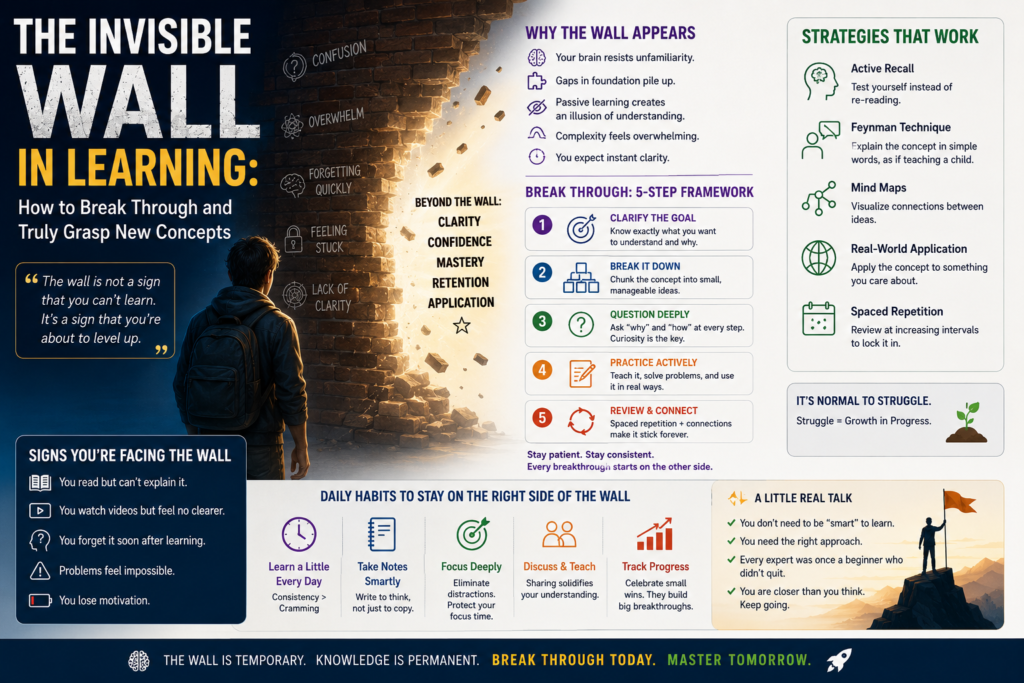
Ever felt like you’re banging your head against a wall while trying to learn something new? You read the textbook, listen to the lecture, maybe even take notes. But when it comes time to actually
the information – in a test, a conversation, or even just to solve a problem – it’s like there’s an invisible wall between you and the knowledge. you studied, you *know* the information was there, but it just won’t click. Trust me, I’ve been there. And I’ve seen countless students and professionals struggle with this exact same thing.
This “invisible wall” isn’t a sign of low intelligence or a lack of effort. It’s often a symptom of how we’re approaching learning. We’re so focused on
information that we forget about the critical step of truly *understanding* it. That’s where the real learning – the kind that sticks with you and empowers you – actually happens. Let’s dig into why this happens and, more importantly, how to break through it.
The Illusion of Learning: Why Rereading Isn’t Enough
Let’s be honest, how many of us have relied on rereading a chapter or reviewing our notes as our primary study method? It’s easy, it feels productive, and hey, you’re looking at the material, right? Wrong.
The mistake almost everyone makes is mistaking familiarity for understanding. Just because you can *recognize* the words on a page doesn’t mean you can *explain* the concepts in your own words or *apply* them to new situations.
This is where most learners struggle. They fall into the trap of passive learning. They’re like sponges, soaking up information without actively engaging with it.
They haven’t connected the dots or made the new information their own. If you’re just passively rereading, your brain isn’t working hard enough to create the neural connections needed for lasting understanding. You’re building a house of cards, not a solid foundation.
The Real Science of How We Learn
Real learning begins when you actively process information. Think of your brain like a construction site. When you’re passively reading, the workers (your brain cells) are just standing around. But when you actively engage with the material
by asking questions, summarizing, explaining it to someone else, or making connections to what you already know – the workers get to work. They start building those crucial neural pathways. This is where memory is created. That’s when the information truly
Here’s the basic process, simplified:
- Encoding: This is the initial stage where you process information. It’s where your brain converts sensory input into a form it can store. This process happens more effectively when you actively engage.
- Storage: Information is stored in your memory, from short-term to long-term. Active processing helps transfer it to the long-term memory, where it can be retrieved later.
- Retrieval: When you need to recall the information, your brain searches and brings it back to your conscious awareness. Strong encoding and effective storage improve this process.
The key takeaway? Learning is not a passive activity. It’s a dynamic process that requires your active participation.
Practical Methods to Break Through the “Invisible Wall”
So, how do you move from passive absorption to active understanding? Here are some practical methods you can use right away:
1. The Feynman Technique
Named after the brilliant physicist Richard Feynman, this technique is brutally effective. Here’s how it works:
- Choose a Concept: Pick a concept you want to understand.
- Teach it to Someone (or Yourself): Explain the concept as simply as possible, as if you were teaching it to a child. The goal is to articulate the concept without using jargon.
- Identify Gaps: Where do you stumble? Where do you get confused? These are your weak areas.
- Go Back to the Source: Review the material, focusing on the areas where you struggled.
- Simplify and Repeat: Explain the concept again, aiming for even greater clarity. Keep repeating until you can explain it in simple terms.
This method forces you to confront your knowledge gaps and build a true understanding. It’s a powerful tool to take down the invisible wall.
2. Active Recall and Spaced Repetition
Instead of rereading, try *recalling*. Close the book and try to remember the key concepts. Write them down, explain them out loud, or draw a mind map. This active retrieval strengthens your memory by forcing your brain to work. Also, space out your reviews over time. Reviewing the material at increasing intervals (spaced repetition) helps move information from short-term to long-term memory. There are many apps and tools available to help with this.
3. The Power of Questions
Don’t just passively accept information. Ask questions! These questions can take several forms:
- Clarifying Questions: “What does this mean?” “Can you give me an example?”
- Connecting Questions: “How does this relate to what I already know?” “How does this apply to [a specific situation]?”
- Critical Questions: “What are the limitations of this concept?” “What are the counterarguments?”
Questioning actively engages your brain and leads to a deeper, more meaningful understanding.
4. Teach, Explain, Discuss
As mentioned in the Feynman Technique, teaching is a phenomenal way to learn. Find a friend, family member, or study partner and explain the material to them. Even if they don’t understand the topic, the act of explaining will help solidify your understanding. Discussions are also key. Get together with others and talk about the concepts. Hearing different perspectives will challenge your assumptions and help you see the material in new ways.
5. Mind Mapping and Concept Mapping
These visual tools help you organize and connect ideas. Start with a central concept and branch out with related ideas, keywords, and examples. This visual organization can make complex information much easier to understand and remember.
6. Contextualize, Contextualize, Contextualize
Abstract information is hard to remember. The human brain loves context. Try to connect what you are learning to real-world situations, problems, or examples. This gives the information meaning and makes it more memorable.
Common Learning Mistakes and How to Avoid Them
We all make mistakes. Recognizing them is the first step to overcoming them.
- The Illusion of Competence: Feeling like you know something because it’s familiar.
- Over-reliance on Highlighting: Highlighting is a passive activity that can easily become a substitute for real understanding.
- Cramming: Trying to cram a large amount of information into your brain in a short amount of time.
- Ignoring the “Forgetting Curve”: Assuming you’ll remember everything forever.
The key to avoiding these mistakes is to be *proactive*. Don’t just go through the motions. Actively engage with the material, question your assumptions, and embrace the challenge of understanding.
The Long-Term Impact: Confidence, Performance, and Beyond
Breaking through the “invisible wall” isn’t just about getting better grades or passing exams. It’s about building a solid foundation for lifelong learning. When you truly understand something, you gain:
- Increased Confidence: Knowing you can grasp complex concepts boosts your confidence in your abilities.
- Improved Performance: Understanding translates to better performance in school, work, and life.
- Enhanced Problem-Solving Skills: Understanding gives you the flexibility to apply knowledge in new and unexpected ways.
- Greater Enjoyment of Learning: When learning becomes less of a struggle and more of a discovery, it becomes enjoyable.
Think about it: the more you truly understand, the less you have to rely on memorization. You can think critically, adapt to changing situations, and build a career, a life, and a future on your terms. That’s the real power of breaking through the invisible wall.
Learning in the Modern World: Digital Tools and AI
We are living in a time of unprecedented access to information. From online courses to AI-powered learning platforms, the opportunities for learning are vast. But this can also be overwhelming. The key is to be a *smart* learner. Use digital tools to your advantage, but don’t let them become a crutch. For example:
- Use online resources to supplement your learning. Find reliable websites, videos, and podcasts that explain concepts in different ways.
- Explore AI-powered tools. Many platforms use AI to personalize learning, provide feedback, and help you identify knowledge gaps.
- Don’t get lost in the digital noise. Use tools like the ones discussed in Stop Drowning in Tabs: A Practical Guide to Taming Browser Overload to stay focused and avoid distractions.
The future of learning is about *personalized learning*. Find the tools and methods that work best for *you*. Experiment, adapt, and never stop learning.
Lifelong Learning: The Skill of the Future
In a world of constant change, the ability to learn is the most valuable skill you can possess. The rate of technological and societal change will continue to accelerate. This means that lifelong learning is no longer an option – it’s a necessity. The skills and knowledge that are in demand today may be outdated tomorrow.
Embrace the challenge of continuous learning. View learning not as a chore but as an adventure. Make it a part of your daily routine. The more you learn, the more you grow, and the more prepared you will be for whatever the future holds. Your future is in your hands – and in your brain.
FAQ: Your Learning Questions Answered
Here are some common questions I hear from learners, along with my experience-backed answers:
- How can I stop forgetting things so quickly? Active recall and spaced repetition are your best friends. Regularly quiz yourself on the material and review it at increasing intervals.
- Is it better to study for long periods or short bursts? Short, focused study sessions with breaks in between are generally more effective than long, uninterrupted sessions. Your brain needs time to process and consolidate information.
- How do I stay motivated to study when I don’t feel like it? Find a study buddy, set specific goals, break down the material into smaller chunks, and reward yourself when you reach those goals.
- I’m easily distracted. How can I improve my focus? Minimize distractions. Turn off your phone, close unnecessary tabs (read Stop Drowning in Tabs: A Practical Guide to Taming Browser Overload for some help with that!), and find a quiet study space. Practice mindfulness and meditation.
- How do I know if I truly understand something? If you can explain the concept in your own words, teach it to someone else, and apply it to new situations, then you probably understand it.
- Is multitasking good for learning? Absolutely not! Multitasking divides your attention and reduces your ability to process and retain information. Focus on one task at a time.
- What’s the best way to prepare for an exam? Start studying early, review the material regularly, use active recall techniques, and practice with past papers.
- How can I make learning more enjoyable? Connect the material to your interests, find a study buddy, and reward yourself for your efforts. Experiment with different learning methods until you find what works best for you.
Breaking through the “invisible wall” is a journey. It takes effort, practice, and a willingness to try new things. But the rewards – increased understanding, confidence, and lifelong learning – are well worth it. So, take that first step. Start questioning, start exploring, and start truly understanding.