
Ever felt like you’re pouring all your energy into studying, only to have the information vanish like smoke the moment you close the book? You’re not alone.
We’ve all been there. It’s the frustrating reality of the forgetting curve, that sneaky little demon that steals our hard-earned knowledge. I’ve seen countless students and professionals struggle with this, and I get it – it’s demoralizing. You put in the hours, you think you understand, and then.
The good news? It’s not about being “bad” at learning. It’s about understanding how your brain actually works and then using that knowledge to your advantage.
This isn’t about some magic hack or overnight transformation. It’s about a shift in mindset and a few simple, powerful strategies that I’ve seen work wonders for people, regardless of their age, background, or learning style.
The Hidden Reality of How We Learn
Let’s get real for a moment. Most of what we’re taught about learning in school is, well, not exactly helpful. We’re told to read, reread, and cram. And what happens? We remember just enough to pass the test, then promptly forget everything.
This is because we’re fighting against our brain’s natural tendency to forget. It’s a survival mechanism. Our brains are designed to filter out unnecessary information to save energy. Only the things that seem important, relevant, or repeated get a free pass into long-term memory.
Real understanding begins when you shift from passive consumption (reading, listening) to active engagement. Think of it like this: your brain is a muscle.
You wouldn’t expect to get stronger by just watching someone else lift weights, would you? The same applies to learning. You need to actively work that “brain muscle” through practice, application, and retrieval.
The Forgetting Curve: Your Frenemy
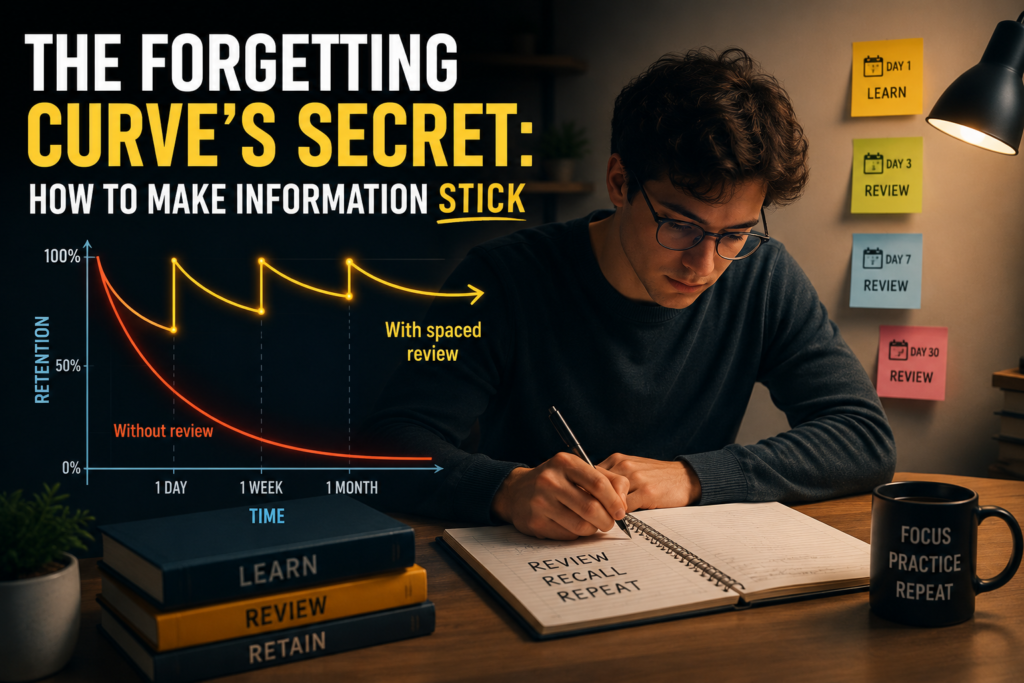
The forgetting curve, first proposed by Hermann Ebbinghaus, is a visual representation of how our memory decays over time. It’s not a straight line down;
it’s a curve that starts steep and gradually flattens out. This means we forget a significant amount of information very quickly after learning it.
Without actively doing something about it, you’ll lose a huge chunk of what you “learned” within a day or two. This is why cramming is so ineffective.
But here’s the kicker: the curve isn’t fixed. You have the power to flatten it, to slow down the rate of forgetting. And that’s where the magic of active recall and spaced repetition comes in.
1. Active Recall: The Power of Retrieval
This is the core of effective learning. Instead of passively rereading your notes (which feels productive but often isn’t), actively try to retrieve the information from your memory.
Close your book or notes and ask yourself: What were the key concepts? What were the main points? Explain them in your own words.
It’s like a mental workout, strengthening the neural pathways that store the information. This is one of the most powerful strategies to improve your learning ability.
Try these active recall techniques:
- Flashcards: Write a question on one side and the answer on the other.
- Practice Questions: Work through problems and quizzes, even if you don’t feel “ready.”
- Explain to Someone Else: Teaching someone else is one of the best ways to solidify your understanding. Pretend you’re explaining the concept to a friend, family member, or even your pet.
- The Feynman Technique: Choose a concept, explain it in simple terms as if you were teaching a child. Identify gaps in your understanding, go back to the source material, and repeat the process until you can explain it clearly.
2. Spaced Repetition: Timing is Everything
This is where things get really interesting. Spaced repetition involves reviewing material at increasing intervals. Instead of cramming all your studying into one session, you space it out over time.
This forces your brain to work harder to retrieve the information, strengthening the memory. There are various spaced repetition systems, from simple notebooks to advanced apps, but the principle remains the same: review, review, and review again, but with strategically increasing gaps in between.
Here’s a basic example:
- Day 1: Learn the material.
- Day 2: Review the material.
- Day 4: Review again.
- Day 8: Review.
- Day 16: Review.
As you get the hang of it, you can adjust these intervals, reviewing more frequently for difficult concepts and less frequently for those you understand well.
3. Interleaving: Mixing Things Up
Instead of studying one topic for hours on end (blocked practice), try mixing different topics and concepts (interleaved practice). This forces your brain to constantly differentiate between ideas, which improves your ability to generalize and apply knowledge. This is a powerful technique for skill mastery across various domains.
For example, if you’re studying math, instead of doing 20 of the same type of problem in a row, mix in problems from different areas of math.
This makes you actively think about which concepts to use, rather than just mechanically applying a formula. When I was learning to code, I found myself getting lost in the details. Then I tried interleaving different concepts (functions, loops, variables) during my practice, and that changed the game.
4. Elaboration: Connecting the Dots
Elaboration is about making connections. How does this new information relate to what you already know? What examples can you come up with? How does it apply to real-world situations? The more you connect new information to existing knowledge, the stronger the memory becomes. It’s like building a network of interconnected ideas in your brain.
Try these elaboration techniques:
- Ask “Why?” Dig deeper. Don’t just accept information at face value.
- Create Examples: Come up with your own examples to illustrate the concepts.
- Teach Someone Else: Explaining something to someone else forces you to elaborate on the concepts.
- Draw Diagrams: Visual representations can help you see the connections.
Common Mistakes Learners Repeat
I’ve seen so many students make the same mistakes over and over. Here are a few to avoid:
- Relying on Passive Learning: Reading and rereading without active recall.
- Cramming: Leaving everything until the last minute.
- Ignoring the Forgetting Curve: Not reviewing material regularly.
- Focusing on Quantity Over Quality: Spending hours studying without actually understanding the material.
- Ignoring Breaks: Your brain needs time to process information. Regular breaks are essential.
The mistake almost everyone makes is assuming that more time spent studying equals better learning. It’s not about the hours; it’s about the quality of those hours and the strategies you use.
Busting Popular Myths
There are a lot of myths out there about learning. Let’s clear up a few:
- Myth: Rereading is an effective study technique.
- Reality: It can feel like you understand the material, but it’s often a shallow form of learning. Active recall is far more effective.
- Myth: Long hours of studying are always better.
- Reality: Quality over quantity. Your brain needs time to rest and consolidate information. Overstudying can lead to burnout and decreased retention.
- Myth: You either “get it” or you don’t.
- Reality: Learning is a process. It takes time, effort, and the right strategies. Anyone can learn anything with the right approach.
- Myth: Cramming is a good way to prepare for an exam.
- Reality: Cramming might help you pass a test, but it does little for long-term retention. Information is quickly forgotten.
Long-Term Impact: Beyond the Grade
Mastering these learning techniques has a ripple effect. It’s not just about getting better grades or passing exams. It’s about:
- Increased Confidence: When you know how to learn effectively, you feel more confident in your abilities.
- Improved Performance: You’re able to learn new skills and information more quickly and efficiently.
- Greater Adaptability: You can adapt to new challenges and learn new things throughout your life.
- Lifelong Learning Mindset: You develop a love of learning and a willingness to embrace new information.
I’ve seen students go from feeling overwhelmed and inadequate to feeling empowered and in control of their learning. It’s a truly amazing transformation.
Modern Relevance: Learning in the Digital Age
In today’s digital landscape, the speed of information is mind-boggling. We’re constantly bombarded with new data, and it’s easy to feel overwhelmed. But the very tools that can contribute to that feeling can also be leveraged to master the learning process.
The rise of AI and personalized learning platforms is changing the game. These platforms can adapt to your individual learning style and provide customized content, making it easier than ever to engage in active recall and spaced repetition.
However, they are most effective when guided by human effort, so you need to know *how* to learn first. This means you need to be intentional and strategic with how you are using these tools. Don’t let the algorithms dictate your learning; take control of your own learning journey.
Future Outlook: Lifelong Learning is the New Normal
The world is changing at an unprecedented pace. The skills you learn today may not be relevant tomorrow. That’s why lifelong learning is no longer a luxury, it’s a necessity.
Being able to learn quickly and effectively, adapt to new information, and constantly update your skills is crucial for success in any field. This makes understanding and conquering the forgetting curve more important than ever. It’s an investment in your future. Embrace the process, and never stop learning.
FAQ: Your Burning Questions Answered
Here are some of the most common questions I get from learners:
- How do I get started with active recall?Start small. Choose a topic and close your book. Try to recall as much as you can. Then, check your notes and identify what you missed. Repeat the process. Use flashcards and practice questions to get started.
- What’s the best spaced repetition tool?Anki is a popular, free, and open-source option. But the best tool is the one you’ll actually use. Start with a notebook and index cards if that’s what works for you. The key is to be consistent.
- How many times should I review material?It depends on the complexity of the material and how well you understand it. Start with reviewing within a day or two, then gradually increase the intervals. Adjust as needed.
- How do I deal with distraction when studying?Eliminate distractions: turn off your phone, close unnecessary tabs, and find a quiet study space. Practice focused attention techniques like the Pomodoro Technique (25 minutes of focused study, followed by a 5-minute break). It’s all about concentration.
- Is it okay to take breaks while studying?Absolutely! Your brain needs time to process information. Take short breaks every hour or so. Get up, move around, and do something different to recharge.
- How can I apply these strategies to different subjects?The principles of active recall, spaced repetition, and interleaving apply to all subjects. Adapt the techniques to suit the specific content. Use flashcards for vocabulary, practice problems for math, and explain concepts in your own words for history.
- How do I stay motivated when learning gets tough?Remind yourself of your goals. Break down your tasks into smaller, more manageable steps. Celebrate your progress. Don’t be afraid to ask for help when you need it. Remember that learning is a journey, not a destination.
- Where can I learn more?There are numerous resources available online, from educational websites to online courses. Seek out reliable sources and don’t be afraid to experiment to find what works for you. Remember that building a career that lasts starts with the ability to learn and adapt.
I hope these strategies empower you to take control of your learning. Remember, it’s not about being “smart,” it’s about being strategic. By understanding how your brain works and applying these techniques, you can unlock your learning potential and achieve your goals. This isn’t just about passing exams, it’s about building a better you.