
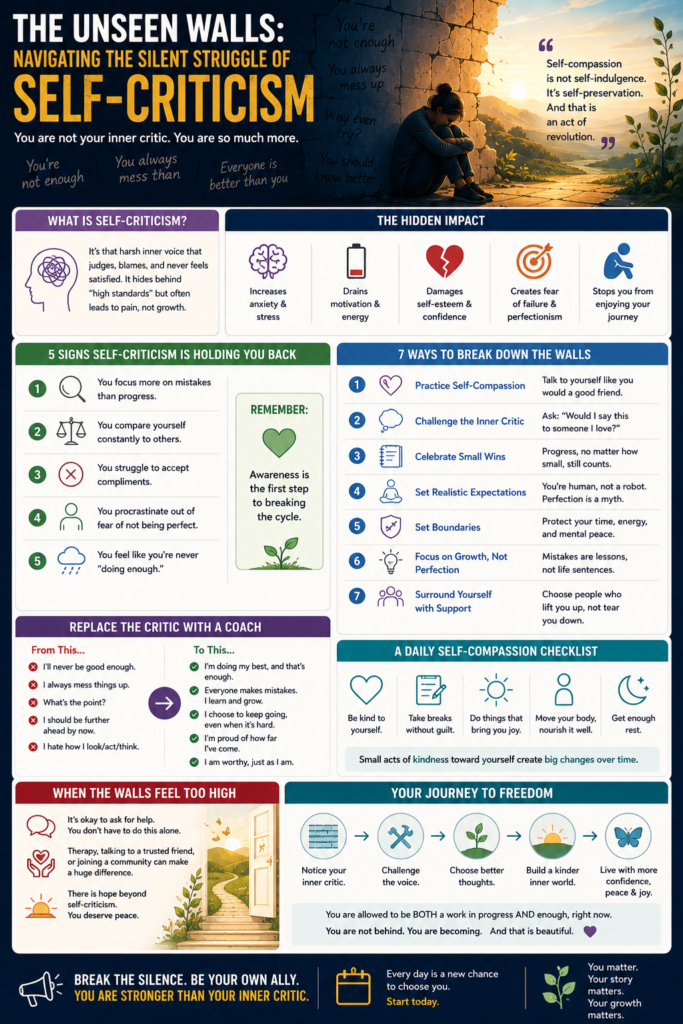
It starts subtly, doesn’t it? A casual comment about your weight, a fleeting glance at someone else’s accomplishments, a sudden wave of inadequacy after a minor setback.
The seeds of self-criticism are often planted in the smallest moments, and they quickly take root, growing into an unseen, yet imposing, wall around your sense of self.
I’ve spent over two decades helping people navigate these internal struggles, and the truth is, we all build these walls. It’s a universal human experience, but that doesn’t make it any easier to dismantle.
This isn’t about the grand, obvious failures. It’s about the everyday whisper of doubt that erodes your confidence, the internal judge that never quite approves, the feeling that you’re somehow always falling short. This silent struggle—this insidious inner critic—is far more pervasive than we often realize. It’s also the very thing that often holds us back from true self-growth. It keeps us trapped.
The Invisible Architecture of Self-Criticism
The walls we build are constructed from a variety of materials. Childhood experiences, societal expectations, past failures, and even well-meaning advice can all contribute.
The problem isn’t always the initial experience, but how we internalize it. We adopt these voices as our own, allowing them to shape our self-perception and, consequently, our behaviors.
Consider the architecture. The foundations are often laid in childhood. Perhaps a parent who was overly critical, a teacher who emphasized perfection, or a peer group that thrived on competition. These early experiences teach us to associate our worth with external validation, making us constantly seek approval and fear judgment. This becomes the mortar that holds the bricks together.
As we grow, new bricks are added. A failed relationship, a career setback, an unmet expectation – each contributes to the structure. We might start comparing ourselves to others, measuring our success against arbitrary standards, or fixating on our flaws. This is where the walls start to become formidable.
Over time, these walls solidify, creating a prison of self-doubt and limiting beliefs. We become afraid to take risks, to pursue our dreams, or to even show the world who we truly are. The fear of criticism, the worry of not being good enough, becomes a constant companion, influencing every decision we make.
The Common Traps of the Inner Critic
The inner critic is a master of disguise. It doesn’t always sound like a harsh voice yelling insults. Often, it whispers subtle judgments disguised as “helpful” advice, “realistic” assessments, or “motivating” pressure. Learning to recognize these traps is the first step in dismantling the walls.
- Perfectionism: This is perhaps the most insidious trap. The critic tells you that you must be perfect to be worthy. It sets impossibly high standards and then berates you for falling short, which is inevitable.
- Comparison: Constantly measuring yourself against others is a surefire way to fuel the critic. There will always be someone who seems more successful, more attractive, or more accomplished. The critic uses these comparisons to highlight your perceived flaws.
- Negative Self-Talk: The critic uses a constant stream of negative self-talk to undermine your confidence. It focuses on your weaknesses, amplifies your mistakes, and dismisses your accomplishments.
- Catastrophizing: The critic has a knack for imagining worst-case scenarios. It anticipates failure and focuses on the negative consequences, often leading to anxiety and avoidance.
Dismantling the Walls: A Practical Guide
Breaking down these walls isn’t about eliminating self-criticism entirely; it’s about transforming it. It’s about creating a more compassionate and realistic inner voice. This is where growth feels slow, as it takes consistent effort and self-awareness.
Here’s a breakdown of the practical steps:
1. Recognize the Critic’s Voice
The first step is simply becoming aware of the critic’s voice. Pay attention to your inner dialogue. What are you telling yourself? Is it kind and supportive, or critical and judgmental? Learn to identify the patterns and triggers that activate the critic. When you hear that negative voice, acknowledge it, and then ask yourself, “Is this voice actually helpful?”
2. Challenge the Critic’s Thoughts
Don’t blindly accept the critic’s pronouncements. Question the assumptions and beliefs it presents. Are they based on facts or fear? Are they realistic? Would you speak to a friend in the same way? Replace negative self-talk with more balanced and compassionate thoughts. This is where you start to chip away at the walls.
3. Cultivate Self-Compassion
Treat yourself with the same kindness and understanding you would offer a friend. Recognize that everyone makes mistakes, experiences setbacks, and faces challenges. Practice self-forgiveness. When you falter, acknowledge it, learn from it, and then move forward with self-compassion. This is a crucial tool in dismantling the structure.
4. Set Realistic Expectations
Perfection is an illusion. Embrace the idea that you are human, and that imperfections are part of the journey. Set realistic goals and celebrate your progress, no matter how small. Focus on the process, not just the outcome. This helps reduce the pressure and diminishes the critic’s power.
5. Practice Mindfulness
Mindfulness helps you become more aware of your thoughts and emotions without judgment. It allows you to observe the critic’s voice without getting carried away by it. By practicing mindfulness, you create a space between you and your thoughts, giving you the power to choose how you respond.
6. Build a Support System
Surround yourself with people who uplift and support you. Share your struggles with trusted friends, family members, or a therapist. Having a supportive network can provide perspective, encouragement, and accountability.
7. Celebrate Your Wins
The critic often minimizes your accomplishments, focusing only on what’s wrong. Make a conscious effort to acknowledge and celebrate your wins, no matter how small. Keep a journal of your achievements and regularly remind yourself of your strengths and abilities. This starts to dismantle the wall from the inside.
Beyond the Walls: Long-Term Impact
The impact of dismantling the walls of self-criticism extends far beyond feeling better about yourself. It affects every aspect of your life.
- Increased Confidence: As you challenge your inner critic and embrace self-compassion, your confidence will naturally grow. You’ll become more willing to take risks and pursue your goals.
- Improved Relationships: When you’re kinder to yourself, you become kinder to others. You’ll develop healthier relationships built on trust, respect, and mutual support.
- Greater Resilience: Self-compassion helps you bounce back from setbacks more quickly. You’ll be less likely to internalize failure and more likely to learn from your mistakes.
- Enhanced Well-being: Reducing self-criticism has a profound impact on your mental and emotional health. You’ll experience less anxiety, stress, and depression.
- Authenticity and Self-Expression: When you stop fearing judgment, you’re free to be your true self. You can express your thoughts and feelings without hesitation, living a more authentic and fulfilling life.
These long-term benefits are not just superficial. They shape your identity, your capacity for joy, and your ability to navigate the complexities of life. This is the true essence of self-growth. This is the goal.
Modern Relevance: The Digital & Emotional Environment
In 2026, the digital and emotional landscape presents unique challenges to self-esteem. Social media fuels comparison and validation-seeking. The constant bombardment of curated images and seemingly perfect lives can amplify the inner critic. The pressure to achieve and succeed is amplified, creating a breeding ground for self-doubt.
Furthermore, technology’s influence extends to how we communicate and process emotions. The filter bubbles of online communities can distort perspectives, leading to polarization and further reinforcing negative self-talk. It’s more important than ever to cultivate self-awareness and critical thinking to navigate this environment.
In the coming years, we will see even more emphasis on emotional intelligence. The ability to understand and manage our emotions, and to recognize them in others, will become increasingly crucial. The good news? The very tools for overcoming self-criticism – mindfulness, self-compassion, and authentic self-expression – are the same tools that will help you thrive in this evolving environment. If you want to Conquer Your Day, that means acknowledging and overcoming the inner critic.
The Future of Emotional Intelligence and Maturity
Looking ahead, emotional intelligence and inner maturity will continue to gain importance. It’s no longer enough to be smart or skilled. The ability to manage stress, build strong relationships, and adapt to change will be essential for success and well-being. This will depend on the ability to handle your inner critic.
The future of self-growth involves:
- Greater Awareness of Trauma: Understanding how past experiences shape our inner critic and developing strategies for healing will become central.
- Integration of Technology: Utilizing technology to support self-awareness, mindfulness, and mental health.
- Emphasis on Community and Connection: Building strong communities that provide support, belonging, and shared experiences.
- Focus on Purpose and Meaning: Cultivating a sense of purpose and meaning to counter the pressures of a fast-paced world.
In essence, the future of emotional intelligence is about returning to basics. It’s about cultivating self-awareness, practicing self-compassion, and building authentic connections. It’s about dismantling the walls and embracing the beautiful, messy, and imperfect reality of being human. If you’re struggling with this, consider visiting Guidebloom.
Frequently Asked Questions (FAQ)
Here are some frequently asked questions about self-criticism:
- Why is it so hard to stop being self-critical?Self-criticism is often deeply ingrained from childhood and reinforced by societal pressures. It becomes a habit, a default way of thinking. Breaking free requires conscious effort, self-awareness, and consistent practice.
- Is all self-criticism bad?No. A small amount of self-criticism can be a motivator for self-improvement. However, excessive or harsh self-criticism is detrimental to your well-being.
- How do I stop comparing myself to others?Recognize that social media and the world only present a carefully curated image. Focus on your own journey, celebrate your unique strengths, and remember that everyone is fighting their own battles.
- What if I’m afraid of being judged?It’s natural to fear judgment. However, remember that most people are preoccupied with their own lives. Focus on your values and your truth, and let go of the need for external approval.
- How can I be more self-compassionate?Treat yourself as you would a dear friend. Practice self-forgiveness when you make mistakes, and remember that everyone experiences difficulties and failures.
- How long does it take to overcome self-criticism?There’s no set timeline. It’s a continuous journey. The more you practice self-awareness, self-compassion, and challenge negative thoughts, the more you will experience relief.
- What if I can’t seem to stop the negative thoughts?If you’re struggling, consider seeking professional help from a therapist or counselor. They can provide support, guidance, and tools to help you manage your inner critic.
- Is there a difference between self-criticism and self-awareness?Yes. Self-awareness involves honestly assessing your strengths and weaknesses. Self-criticism is when this awareness becomes overly harsh, judgmental, and focused on perceived flaws.