
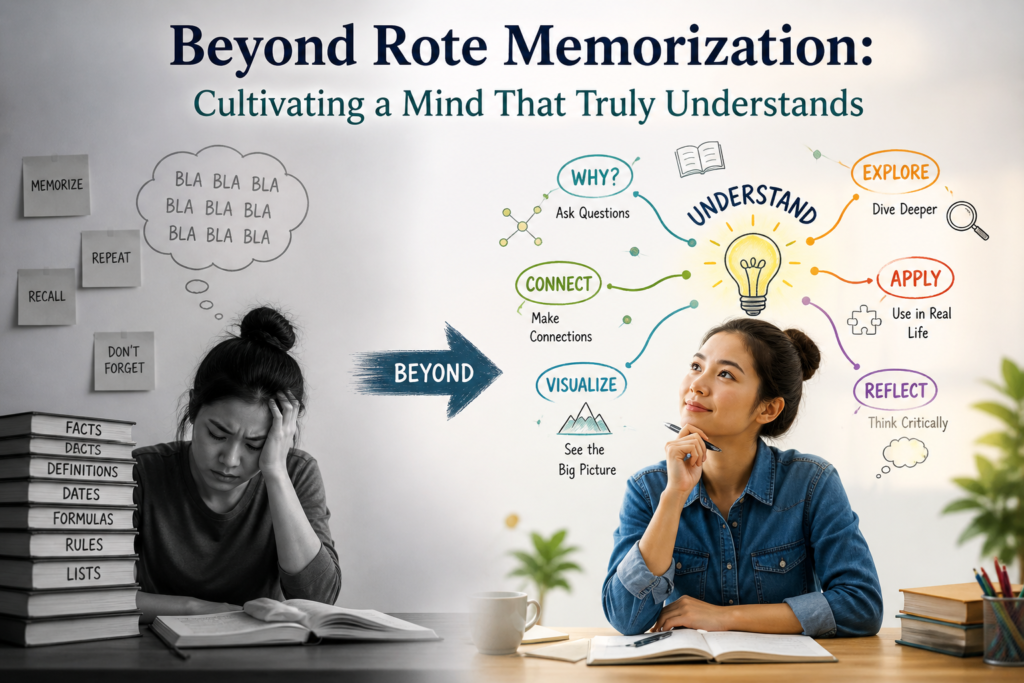
I remember a student, let’s call him Rohan, who came to me drowning in frustration. He’d spend hours poring over textbooks, highlighting every other sentence, and could recite facts verbatim just before an exam. Yet, a week later, it was as if his brain had hit a reset button.
This isn’t about a lack of intelligence or effort. More often than not, it’s about the *way* we’re trying to learn. We often fall into the trap of what I call “surface learning” – a method focused on memorizing facts and figures without truly engaging with the material. Think of it like trying to build a house by stacking bricks without a foundation. It might look okay for a while, but the first strong wind will show its instability. Real learning, the kind that transforms your capabilities and builds genuine confidence, is a different beast entirely. It’s about building connections, making sense of information, and being able to apply it in new contexts. It’s about cultivating a mind that truly understands, not just one that can recall.
The Architecture of Understanding: How Our Brains Actually Learn
Before we can build better learning habits, it’s essential to get a sense of how our brains are wired for learning. Forget the idea of a brain as a simple hard drive that just stores data. It’s far more dynamic, more like a bustling city. Every time you learn something new, it’s not just adding a file; it’s building new roads, strengthening existing pathways, and creating new connections between different districts of the city. This process is called neuroplasticity, and it’s the fundamental mechanism behind all learning.
When you encounter new information, your brain tries to make sense of it by connecting it to what you already know. This is where the magic happens. If the new information is just a random piece of data, it’s hard for the brain to latch onto. But if you can relate it to a past experience, a concept you already grasp, or even an emotion, it creates a much stronger neural link. This is why stories are so memorable, and why analogies can be powerful learning tools.
Think about learning a new language. Simply memorizing vocabulary lists is tough. But if you learn words in the context of a conversation, or associate them with images or real-life situations, they become much easier to recall and use. Your brain is actively building those connections, making the language a living, breathing part of your cognitive landscape, rather than a dusty dictionary.
Furthermore, learning isn’t a passive activity. It’s an active construction. The more you actively engage with the material – questioning it, debating it, trying to explain it to someone else – the more robust those neural pathways become. This active engagement is the bedrock of deep understanding. It moves you from simply ‘knowing’ a fact to truly ‘understanding’ its implications and nuances.
Moving Beyond the Smear: Practical Systems for Deeper Learning
So, how do we shift from that frustrating cycle of fleeting knowledge to building lasting understanding? It requires intentionality and adopting a few practical, experience-tested systems. These aren’t quick fixes or ‘hacks’; they are foundational shifts in how you approach learning.
The Power of Elaboration: Asking ‘Why’ and ‘How’ Relentlessly
This is where most learners falter. They read, they highlight, they maybe even summarize, but they rarely dig deep enough. Elaboration is the art of expanding on information by connecting it to other ideas, personal experiences, and existing knowledge. It’s about asking yourself:
* “Why is this important?”
* “How does this relate to what I already know about X?”
* “What are the implications of this?”
* “Can I think of a real-world example of this?”
Let’s say you’re learning about the concept of supply and demand in economics. Instead of just memorizing the definition, you would ask: “Why does the price of concert tickets go up when the band is popular? How is this different from the price of everyday groceries? What happens if there’s a sudden shortage of a key ingredient for a popular snack?” By probing with ‘why’ and ‘how,’ you’re forcing your brain to create richer connections. This is a far more effective way to cement understanding than just rereading the textbook definition a dozen times.
Spaced Repetition: The Gentle Reinforcement
The forgetting curve is a harsh reality for many learners. We encounter new information, we learn it (or think we do), and then, as time passes, it fades. Spaced repetition is a learning technique where you review information at increasing intervals. Instead of cramming, you revisit the material just as you’re about to forget it. This signals to your brain that this information is important and worth retaining.
Tools like Anki or Quizlet use algorithms to automate this, but you can also implement it manually. After learning a new concept, review it the next day, then three days later, then a week later, and so on. Each time you successfully recall the information, the interval before the next review can lengthen. This isn’t about testing yourself to failure; it’s about gentle, strategic reinforcement. It feels less like a chore and more like a natural way to build a robust memory.
The Feynman Technique: Explaining It Simply
Named after the Nobel Prize-winning physicist Richard Feynman, this technique is deceptively simple and incredibly powerful for uncovering gaps in your understanding. Here’s how it works:
- Choose a concept you want to understand.
- Explain it in simple terms, as if you were teaching it to a child or someone completely unfamiliar with the subject. Write it down.
- Identify the areas where you struggled to explain it clearly, or where you had to use jargon. These are your knowledge gaps.
- Go back to the source material (textbook, notes, etc.) and review those specific areas.
- Simplify your explanation again, incorporating what you’ve learned, until you can explain it clearly and concisely without complex terms.
The beauty of the Feynman Technique is that it forces you to distill complex ideas into their core components. It’s a brilliant diagnostic tool. When you can’t explain something simply, it’s a clear sign that you don’t truly understand it yet. This is where most learners struggle; they think they understand because they recognize the terms, but they can’t articulate the underlying principles. Real understanding begins when you can translate sophisticated ideas into accessible language. This method is also fantastic for preparing for exams where clear communication of concepts is key.
Common Pitfalls: The Learning Mistakes We Keep Making
Even with the best intentions, we often find ourselves falling back into old, ineffective habits. Recognizing these pitfalls is the first step to overcoming them.
The Myth of Rereading: Passive Immersion vs. Active Engagement
This is perhaps the most pervasive learning myth. We believe that rereading our notes or textbooks multiple times will somehow magically implant the information into our brains. The truth is, rereading is often a passive activity. We might feel like we’re learning because the material looks familiar, but this familiarity can be deceptive. It doesn’t necessarily translate to recall or application. It’s like looking at a map you’ve seen many times; you recognize the roads, but you can’t necessarily navigate them effectively without active practice.
The mistake almost everyone makes here is confusing familiarity with mastery. True learning requires active recall, practice, and application, not just passive exposure. Instead of rereading, try testing yourself on the material, summarizing it from memory, or applying it to a new problem.
The Long Hours Fallacy: Quality Over Quantity
Many believe that the longer they study, the more they will learn. While dedicated study time is crucial, simply clocking in long hours without effective strategies can be counterproductive. Exhaustion leads to diminished cognitive function, making it harder to focus, retain, and process information. Trying to study for 8 hours straight often results in less effective learning than two focused, well-structured 3-hour sessions with breaks.
Think of your focus like a muscle. It can be trained, but it also needs rest. High-intensity, focused study sessions followed by breaks are far more effective than marathon, low-engagement study periods. This is about working smarter, not just harder. Your brain needs time to consolidate information, and constant bombardment without breaks can hinder this process.
The Illusion of Understanding: Spotting the Gaps
This ties back to the Feynman technique. We often feel like we understand a topic because we’ve read about it or seen it explained. However, when asked to apply it, explain it, or work through a related problem, we hit a wall. This “illusion of understanding” happens because we haven’t actively tested our knowledge or sought out the nuances. We’re good at recognizing information, but not necessarily at retrieving or applying it.
To combat this, actively seek out opportunities to test your understanding. Work through practice problems, try to explain concepts to others, or even teach yourself. Where you stumble, that’s precisely where you need to focus your learning efforts. This self-testing is a vital part of building genuine comprehension.
The Ripple Effect: Confidence, Performance, and Lifelong Growth
Mastering the art of learning is not just about acing exams. It’s about building a foundation for lifelong success and confidence. When you move beyond surface-level memorization and cultivate deep understanding, several things happen:
- Increased Confidence: Knowing you can genuinely grasp complex ideas and retain them builds immense self-belief. This confidence spills over into all areas of your life.
- Improved Performance: When you truly understand a subject, you can apply it more effectively. This leads to better problem-solving, critical thinking, and innovation, whether in academics, your career, or personal projects.
- Enhanced Adaptability: In today’s rapidly changing world, the ability to learn new skills and adapt to new information is paramount. Deep learning habits equip you to navigate this landscape with ease.
- Greater Enjoyment of Learning: Learning stops feeling like a chore and starts feeling like an adventure. The satisfaction of truly grasping a concept is incredibly rewarding.
This is where genuine intellectual growth takes root. It’s about developing a growth mindset – the belief that your abilities and intelligence can be developed through dedication and hard work. The techniques we’ve discussed, like elaboration and the Feynman technique, are not just study methods; they are tools for cognitive development.
Learning in the Digital Age: Navigating the Information Deluge
We live in an era saturated with information. The internet, online courses, and AI-powered tools offer unprecedented access to knowledge. However, this abundance also presents new challenges. Distractions are everywhere – notifications, endless social media feeds, the temptation of short-form entertainment. The sheer volume of data can be overwhelming, leading to information overload.
In this digital environment, the principles of deep learning become even more critical. Instead of passively consuming content, we need to be active navigators. This means:
- Curating Your Information Diet: Be selective about the sources you engage with.
- Practicing Digital Minimalism: Minimize distractions by turning off unnecessary notifications and setting boundaries for digital consumption.
- Leveraging AI Wisely: AI tools can be powerful learning aids for summarizing complex texts, generating practice questions, or explaining concepts in different ways. However, always critically evaluate the AI’s output and ensure you are still engaging your own cognitive processes. Don’t let AI do the thinking for you.
- Focusing on Application: With so much information readily available, the true value lies in what you can *do* with it. Use online resources to find problems to solve or projects to undertake where you can apply your learning.
The ability to discern reliable information from misinformation, and to synthesize disparate pieces of data into coherent understanding, is a superpower in the 21st century. This is where Guidebloom aims to assist, providing resources and strategies to help individuals navigate this complex learning landscape.
The Future is Learner: Embracing Lifelong Learning
The pace of change in industries and technology means that formal education is just the beginning. The concept of a “job for life” is becoming increasingly rare. Instead, we are looking at a career journey that will involve continuous learning, upskilling, and reskilling. The importance of lifelong learning cannot be overstated. It’s not just about staying relevant in the job market; it’s about personal growth, adaptability, and maintaining a curious, engaged mind throughout life.
Cultivating effective learning habits now will set you up for success in the decades to come. It means developing the discipline to seek out new knowledge, the curiosity to explore unfamiliar territories, and the resilience to navigate the inevitable challenges that come with learning. The ability to learn, unlearn, and relearn is the ultimate future-proof skill.
So, the next time you find yourself staring blankly at a page, or feeling that familiar frustration of forgotten information, remember Rohan. Remember that real understanding is built, not memorized. It’s cultivated through active engagement, strategic review, and a relentless pursuit of clarity. It’s a journey, and every step you take towards deeper learning is a step towards a more capable, confident, and adaptable you. This journey starts with understanding how your mind works and then intentionally building systems that support genuine comprehension. Explore more on how to master your learning process at Guidebloom.
Frequently Asked Questions About Deeper Learning
Q1: I feel like I understand something while studying, but I forget it later. What am I doing wrong?
This is a very common experience, often stemming from what we call “passive learning.” You might be recognizing the information when you see it, but you haven’t truly encoded it into your long-term memory. To fix this, try active recall. Instead of just rereading, close your book and try to explain the concept aloud, write down key points from memory, or create flashcards. Techniques like the Feynman method, where you teach the concept to someone else (or an imaginary person), are excellent for revealing and filling these gaps.
Q2: How much time should I dedicate to studying each day to actually learn and retain information?
It’s less about the sheer quantity of hours and more about the quality and strategy of your study sessions. Marathon study sessions without breaks can lead to burnout and diminishing returns. Aim for focused, intentional study periods – perhaps 45-60 minutes at a time, followed by short breaks. Use this focused time for active learning techniques. Spaced repetition is also key; revisiting material at increasing intervals is far more effective than cramming everything in one go.
Q3: Is highlighting useful for learning, or should I stop doing it?
Highlighting can be a useful *first step* to identify key information, but it’s rarely enough on its own. The danger is that it can become a passive activity that creates a false sense of engagement. If you highlight extensively, you’re not really pinpointing what’s most important. Try to be highly selective with your highlighting, and always follow it up with active learning methods like summarizing, quizzing yourself, or elaborating on the highlighted points. Ask yourself: “Why is this highlighted? What does it mean in the bigger picture?”
Q4: I struggle with complex subjects that seem abstract. How can I make them more concrete?
Abstract concepts are challenging because they lack immediate real-world grounding. To make them concrete, focus on making connections and finding examples. Ask yourself: “Where can I see this principle in action in the real world?” Use analogies, draw diagrams, or create visual metaphors. The Feynman Technique is particularly useful here; trying to explain an abstract concept simply often forces you to find relatable touchpoints. Don’t be afraid to seek out case studies, practical applications, or even real-life stories related to the abstract idea.
Q5: How does AI impact how we should approach learning today?
AI is a powerful tool, but it can also be a crutch. It’s excellent for tasks like summarizing lengthy texts, generating practice questions, or explaining concepts in different ways. However, relying solely on AI to do the thinking for you will hinder your own learning development. Use AI as a supplement: ask it to explain something you’re struggling with, or to quiz you on a topic after you’ve studied it. But always ensure you are actively engaging your own brain, critically evaluating AI-generated content, and practicing retrieval and application yourself. The goal is to augment your learning, not replace it.
Q6: What’s the difference between cramming and effective revision?
Cramming is trying to absorb a large amount of information in a short period, typically right before an exam. It leads to short-term retention but poor long-term understanding. Effective revision, on the other hand, is a spaced and systematic process. It involves revisiting material at increasing intervals (spaced repetition), actively testing your knowledge, and focusing on deeper understanding and application rather than just memorization. Revision should be an ongoing process, not a last-minute panic.
Q7: I get easily distracted when studying, especially online. How can I improve my focus?
Distraction is a major hurdle in modern learning. First, create a dedicated study environment with minimal distractions. Turn off non-essential notifications on your devices. Use website blockers if necessary. Techniques like the Pomodoro Technique (short, focused work intervals with breaks) can help train your attention span. Also, ensure your study material is engaging; if you’re finding it dry, try to find ways to make it more interactive or relate it to your interests. Sometimes, just acknowledging the distraction and gently bringing your focus back is the most effective strategy.